Kategorien
Alienation Kritik Material Praxis

Entprofessionalisieren statt proper applizieren


https://direct.mit.edu/octo/article/doi/10.1162/OCTO.a.539/135707/New-York-Real-Estate-and-the-Ruin-of-American-Art

https://www.artnews.com/art-news/artists/josh-kline-new-york-art-world-viral-essay-interview-1234780103/

„At White Columns back in 2010, Matthew Higgs championed the community of artists I was a part of when no one else was ready to do so. My point isn’t to drag the nonprofits. It’s about the importance of true artist-run spaces and about restoring agency to artists. It’s about what’s missing. There’s an important distinction between these institutional alternative spaces and real artist-run spaces. {…) In true artist-run spaces, the artists running them don’t check their identity as artists at the door. They don’t have to be professional.“

mich interessiert hauptsächlch der Aspekt: weg von den Institutionen, sich nicht andienen, nicht überlegen, was die wohl wollen und darauf hingerichtete Applications schreiben, um Unterstützung betteln, sondern umgekehrt: selber rausfinden, was man will und dabei die ganze Gegenwart einbeziehen aus eigenem Erleben heraus und daraus was machen. Eigene Räume. Machen, was es nicht gibt. Machen, was man will. das geht vielleicht nicht mehr in Städten wie New York, aber muß ja auch nicht. Andere Orte.

_________________
„American Artist, Jean-Michel Basquiat, Huma Bhabha, Black Quantum Futurism, Cecily Brown, Nicole Eisenman, Jason Fox, Nikita Gale, Georgia Gardner Gray, Josh Kline, Ella Kruglyanskaya, Carolyn Lazard, Guadalupe Maravilla, Paul McCarthy, New Red Order, Monira Al Qadiri, Farah Al Qasimi, Jesús Hilario-Reyes, Alicia Riccio, Tschabalala Self, Avery Singer, Tavares Strachan, Sung Tieu, Wolfgang Tillmans, Rirkrit Tiravanija, Ambera Wellmann, Anicka Yi – Studio Visit: A Curatorial Project by Anicka Yi and Josh Kline for Performance Space New York – Hauser & Wirth – *
This shit sucks, plain and simple. The gallery is a maze of cubicles, the walls printed with dumb AI-generated images of artist’s studios generated from written descriptions of their studios from early in their career, with a work from each artist slapped on top of it. It’s ugly as sin and, like Josh Kline’s crappy essay, clearly driven by a midlife crisis nostalgia for the salad days. You can almost smell the desperation of these artists, many of them trapped in mid-career freefall, begging the art world for a post-internet revival so they can get back to feeling cool and accomplished and financially secure. I guess I’ll use this opportunity to air the few thoughts I had on Josh’s essay, which, if you haven’t read it, is here. Obviously, by and large, everything he’s complaining about is entirely correct, New York is indeed very expensive and the whole art system is antithetical to supporting artists, sustaining artistic communities, etc., and for people who don’t already know these things it’s a good compendium of the facts. For those that already know that and live here, it’s embarrassingly out of touch and even naive. He seems unaware that anyone younger than him has ever started an alternative project space in the city, he feels entitled to an endless upward career trajectory and an infinite fabrication budget (three years out from a Whitney retrospective and having organized this exhibition at a mega gallery), as if it’s simply „not his problem“ that his practice has aged like milk and no one cares about it anymore. Of course the whole situation is terrible, but moving to Philadelphia is not going to bring back your twenties and no one can manifest the return of the early ’00s by force of will. For all his focus on economic structures, he doesn’t go so far as to comprehend that the financialized economy that’s made everything more expensive is the same one that enriched the people who bought his art, which, if he could admit it, might at least suggest the entropic complexity of the problem and curb his self-righteousness about declaring that things should go right back to how they were back in his day. What’s most annoying, though, is that his „political“ outlook appears to be trapped in a literally 20-year-old mode of liberal participatory optimism that actually believes that artists can simply use their agency to make rents cheaper, and then I guess we’ll „make this the funnest summer in world history.“ So his diagnosis is fine, although I thought most of it went without saying, but the prescription is hopelessly undercooked and narcissistic, incapable of conceiving why the world wouldn’t stay the way it was when it worked for him and focused only on getting it back to that, even though his only idea is to gentrify a smaller city. What he can’t face up to is that the world has changed, certainly for the worse, and artists have to come to terms with that as an unfortunate fact of life. Those changes very much don’t work for him, but younger artists have to get by somehow and, in fact, some do. I’m not even saying artists shouldn’t move to Philly if they want to, I don’t want to dictate the correct way for anyone to do anything. The issue is that the article presents itself as a principled insight when it’s really just the author trying to avoid admitting his career has been left behind. Which I understand, the art market has been particularly cruel to artists who were on top of the world 15 years ago, and after you’ve had major museum retrospective it’s fair to expect that you won’t need to give up and go back to school to become an RN or whatever. Still, times change, and if you want to improve anything you have to adapt to those conditions. Josh’s fantasies about a revival of the Providence DIY scene in Pennsylvania (or Indonesia) are like expecting to step in the same river twice or, I dunno, thinking Woodstock ’99 was going to be like Woodstock ’69.“

s t a r k

https://manhattanartreview.com/manhattanartreview.html

________________________________

https://thereader.mitpress.mit.edu/the-1960s-art-school-experiment-that-redefined-creativity/

_____________
https://taz.de/Kuenstler-Robert-Rauschenberg-in-New-York/!6174383/

Rauschenberg gilt als der innovativste Künstler dieser Generation. Sein Freund und Liebhaber Jasper Johns sagte einmal, er sei der erfinderischste Künstler des 20. Jahrhunderts nach Picasso gewesen. Der Kritiker Jerry Saltz nennt ihn einen „dionysischen Rebellen des Experiments.“ Rauschenberg befreite sich selbst und die Kunst von jedem vertrauten Vokabular und erweiterte den Kunstbegriff ins Unendliche.

________________
Adorno, Ästhetische Theorie 1970.
Leseprobe
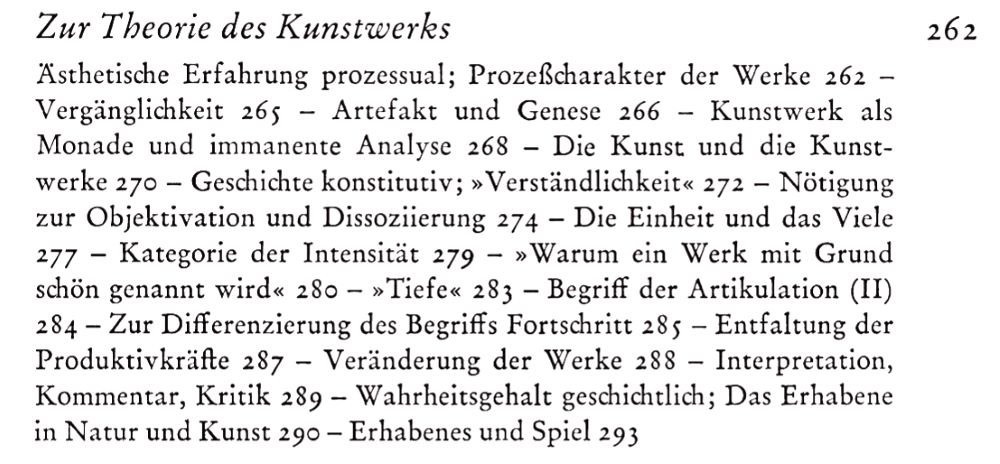
aus dem Inhaltsverzeichnis

_________________
Freundlich zugewandter Eigensinn.
sich für quasi ALLES zu interessieren und umsetzen wollen

Zum Tod von Alexander Kluge eine Lange Nacht
3 Stunden auf Deutschlandfunk Kultur, Erstsendung 2010

______________________

Short Supply | Mollie & Bek

https://www.instagram.com/p/DYAM2eZDKx1/

____________________

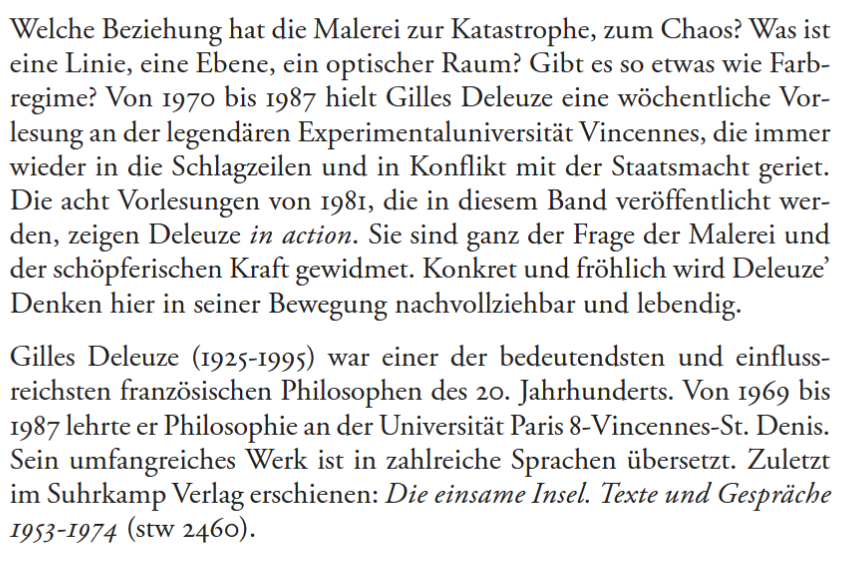
Gilles Deleuze: Über die Malerei (1981)

Leseprobe

Kategorien
Kritik Material Outside Vienna Praxis Zeitgeschichte ZKF-Erweiterung

ne travaille jamais !

( … a.k.a. wir müssen hier raus! )

… Hanna Mittelstädt war neulich an der Akademie und hat gelesen aus der surrealistische Zeitschrift. Hier Nachtrag (zum hören) und weiter mit Situationisten und Subrealisten:

https://99zueins.fireside.fm/588

Kategorien
Alienation Kritik Outside Vienna Praxis Zeitgeschichte

DROHNEN

aktuelles Interview mit H S

INTERVIEW

und einer der erwähnten Filme

NOVEMBER 2004

Kategorien
Kritik Material Outside Vienna Praxis Unterhaltung Zeitgeschichte

Sehen/Hören

both in English language…

Listen/looking at:

1. Selection – VIENNA General History Basics

VIENNA

2. Selection – NYC Art History Basics

NYC

Kategorien
Praxis

Yellow Exit. Lucijan quoting Alastair in his diploma text


I asked Lucijan Osvald from the Figuration Department if I could share an excerpt from his diploma thesis here with you.

Because of a fantastic helpful and wise advice he got from Alastair MacKinven: truly paint.


to really really paint

___________________________

Kategorien
Alienation Kritik Material Pizzicato-Geigen-Untermalung Praxis Zeitgeschichte

Kalenderwoche 50

Lieber Fachbereich,

wir hoffen, es geht euch allen gut!

heute treffen wir uns um 15 Uhr im 117.

Jiaxi zeigt seine Arbeit, verbunden mit artistic research.

Um ca 16 Uhr brechen wir auf ins mumok.

Manuela Ammer führt uns freundlicherweise durch die von ihr kuratierte Ausstellung von Liliane Lijn: Arise Alive

https://www.mumok.at/ausstellungen/liliane-lijn

weiterer Programmpunkt:
Veranstaltung zum Erscheinen des neuen Buches von Helmut Draxler „Was tun? Was lassen? Politik als symbolische Form“

mit anschließender Podiumsdiskussion unter Beteiligung von Antonia Birnbaum, Stephan Gregory und Eva Kernbauer

Im Anschluss an die Veranstaltung gibt es ein kleines Buffet

Dienstag, 10. Dezember 2024, 18.00 Uhr
Ort: die Angewandte
Seminarraum 21 (4. OG)
Vordere Zollamtsstraße 7, 1030 Wien

https://www.dieangewandte.at/aktuell/aktuell_detail?artikel_id=1733283735327

"Die Vorstellung, es gebe keine Unterscheidung mehr zwischen Kunst und Kultur oder zwischen Kunst und Politik, alles seien bloß 'kulturelle Praktiken' und darin löse sich alles in gleichsam empirische Differenzen auf, die man endlos ausbreiten kann, ist mir zunehmend unheimlich geworden. Meine konkrete Erfahrung war nämlich, und ich war damals selbst noch ein ganz großer Deleuze-Fan, letztlich eine andere. Meine Erfahrung war, dass sich diese Begriffe nicht einfach auflösen und dass wir eher versuchen müssen, mit den historischen Differenzen und den damit gegebenen Widersprüchen umzugehen. Und das heißt natürlich Dialektik! Es bedeutet, Kunst und Politik nicht einfach auf ein gemeinsames Programm der unendlichen Differenzierung zu projizieren, sondern sie in ihrer Differenz anzunehmen und in ihrer Konflikthaftigkeit zu diskutieren." 

H. Draxler 2023
Abstrakt Action Handykiste


Pollesch, 2019

Kategorien
Kritik Praxis

Dienstag aus Licht

Avocado Ibuprofen

Dieses Bild hat ein leeres Alt-Attribut. Der Dateiname ist grafik-1.png

______________________

Danke für die schönen Beiträge/ Sommerberichte hier im Blog.
(ALLE Fachbereichsmitglieder sind eingeladen)

Im kommenden Semester treffen wir uns immer dienstags.

Der ACTION DIENSTAG wird ungefähr so aussehen:

13 – 15 Ausstellungsbesuche

15 – 17 Klassenbesprechung im 117

17 – 19 Film im 117

+ mehr Ausflüge!

Start: 8.10.24

see you

M

Kategorien
Praxis

Habima Fuchs

We are looking forward to the artist Habima Fuchs, who will show us her new film EQUINOX. The screening together with an introduction by the artist is expected to take place on October 17 at the Academy of Fine Arts, Vienna.

About Habima Fuchs and her movie:

EQUINOX

A screening of Habima Fuchs art film EQUINOX, 2022, (23 min.) with an introduction about the creative process.

„The nature of the universe, which holds
the center still and moves all else around it,
begins here as if from its turning-post.“
(Dante Alighieri, Canto 27, 106-117)

Habima Fuchs evocative art film captures the world at the symbolic equinox. It is set in Slunakov near Olomouc, Czech Republic and was produced as part of the Home and World programme of the Olomouc Museum of Art – Central European Forum. (https://muo.cz)

Habima Fuchs is a Czech visual artist whose work has long been revising the established mechanisms and traditional existential, philosophical or metaphysical turns that we rely on to understand the world we live in. The symbols and motifs she reflects and materializes in this process come from different cultures and periods, from the framework of Christian iconography and oriental religious contexts. The result is an exceptionally compelling imagery, seductive and subversive, but also deeply self-critical. (Barbora Kundračíková, curator of MUO and producer)

Habima Fuchs, born in Ostrov (former Czechoslovakia), spent many years in Berlin, where she devoted herself to artistic practice, and then made numerous walking trips through Europe to study its culture and mythology from an immediate experience. All of this is reflected in her work, whose means of expression are usually drawing and ceramics, occasionally also other artistic media in the form of a spatial installation. She currently lives in the Czech Republic and, among other things, studies the theory of the five elements and bioinformation technology.  Her work has been exhibited in solo exhibition f.e. in Fait Gallery in Brno (Matter in Eternity, 2024), in SVIT gallery in Prague (The Great Ocean Continuously Creating, 2019), in Kunstverein Munich (297, 2018), in Warhus Rittershaus, Cologne (Eyes horizontal, nose vertical / foster the eminent dance, 2016) or ZACHETA in Warsaw (Salt Sea Water Absorbed by Clouds Turns Sweet, 2016) and in Open Art Project in Otwock (AGAVE, Finding the Source, 2015).  She participated in groupe exhibitions in PLATO, Ostrava in 2022, Rudolfinum, Prague and Biennale Gherdëina 7 in Ortissei in 2020, Arthena Foundation in Duesseldorf, Galerie Guido W. Baudach, Berlin in 2017 among others. She completed residencies in Germany, Slovakia, Italy, Switzerland or Norway. She works with SVIT gallery in Prague. 
Equinox

Habima Fuchs is the type of artist who draws heavily on lived cultural history and philosophy in her work. She draws on her rich experience of both European and Eastern traditions. She combines the principles of both and by synthesising them she arrives at a new conception of the world, which she also envelops in a similarly complex mythology. The metaphorical way of thinking is reflected in the meaning as well as in its formal or visual side – her way of communication is distinctly aesthetic, each element fulfils its role in the story, yet it can hardly be reduced to a simple interplay of elements. The image of the world she creates is therefore truly finit, complete, almost autonomous, while at the same time not lacking the fragility that every creative gesture possesses. Habima´s work is always personally experienced, it is not an “empty game of art”, but at the same time it offers enough space for our own imagination. What she aims at, therefore, is not simple timelessness, she does not offer us an escape from the present situation, on the contrary – if we give it a chance, we will find that her work reveals and re-shapes the so-called present in a very sophisticated way. 

The project, prepared by Habima Fuchs for Olomouc and created within the framework of the Year of Home and Abroad, is entitled Equinox. It is a combination of a performance, which took place in the Ecological Centre Sluňákov, and a poetic film, set, among other things, in the spaces of the local Arch – the Garden of Paradise by František Skála and the Solar Mountain by Miloš Šejn. The story of the return to the equilibrium “world of the centre”, the world before the flood, Dantes Paradise, is depicted in eleven images, the central role of which is played by the burying of the snake, the planting of the apple tree and the cutting of the hair. The individual images are conceived as self-contained wholes, encompassing a range of familiar objects and gestures, elevated to the level of transcendence within the ritual. The burning candle, the apple, the grazing cattle, and the “marginal” – but in fact monumental – dramatic entries of family members whose kinship is subtly indicated by common features, contribute to a strongly metaphorical vision of the world. Watching the film, we go through a process of personal purification with the author, while being reminded of our own absolute belonging to the community.

Kategorien
Material Praxis Zeitgeschichte

Interview mit Günther Förg zum malerischen Werk 

Geführt von Erich Gantzert-Castrillo am 17.07.2007 

EGC: Günther, Du hast von 1973 bis 1979 an der Münchner Kunstakademie bei Karl Fred Dahmen Malerei studiert und in Deiner ersten Ausstellung 1974 in der Akademie sechs graue Bilder gezeigt. Den Angaben zufolge sind diese auf Nessel mit Dispersion und Kreide gemalt. In den folgenden Jahren hast Du ein großes Konvolut an Bildern auf so unterschiedlichen Bildträgern wie Blei, Leinwand, Cotton duck, Kupfer, Holz, Sperrholz, Hartfaserplatten, Pressspan, Aluminium, Masonit und Polyestergewebe geschaffen. Zu den schon erwähnten Farben – Dispersion/Kreide – kommen Acryl, Ölfarbe, Tempera und Luftlack und auch Blattgold dazu. In der Zeit von 1974 bis 1990 hast Du immer wieder Nessel als Bildträger verwendet und mit unterschiedlichen Farbsystemen bemalt, wie: Dispersion/Kreide, Acrylfarbe und Ölfarbe. 1990 hast Du neben einer vierteiligen eine dreiteilige Shaped Canvas-Arbeit geschaffen, hier liegt der Nesselstoff über Holz. Deine ersten sechs grauen Bilder in der Klasse von Karl Fred Dahmen hast Du mit Dispersion und Kreide auf Nessel gemalt sowie zwei weitere, die im Besitz Deiner Tochter Cécile sind. In dem Gespräch, das Du mit Thomas Groetz geführt hast, fragt er Dich: »Die monochromen Bilder im Frühwerk sind zunächst grau und schwarz, haben diffuse und stumpfe Oberflächen und entfalten dann langsam ihre Farbigkeit, quasi aus einer Negation heraus. Ist diese Beobachtung zutreffend?« Du antwortest darauf: »Die grauen Bilder, die in den ersten 3 Jahren an der Akademie gemalt wurden, sind aus einer gewissen Verweigerungshaltung heraus entstanden. Über einer schwarzen Grundierung liegt ein grauer Schleier, ähnlich einer gewischten Schultafel. Jedes Grau oder Schwarz hat eine Farbigkeit, die über einen Vergleich mit anderen Farben erfahrbar wird.« Hast Du die Materialien aus Kostengründen so gewählt oder weil Du mit dieser Materialwahl die gewünschte Bildvorstellung erreichen konntest?

Kategorien
Material Praxis Zeitgeschichte

non-finito Vollkontakt


Der Fachbereich Abstraktion lädt herzlich ein zur Ausstellung non–finito Vollkontakt. Die schönsten Probleme der Welt, ein Gruppen-Ganzes aus abstrakten Problemformalisierungen, konkreten Materialkonfrontationen und unfertigen Gruppenbegehren.

Wenn die Kunstproduktion allgemein und der malerische Prozess im Besonderen ein Vollkontakt ist – mit dem Material, mit der Arbeit als endlose Aufgabe, mit dem Anspruch der Kunst, mit den eigenen Unzulänglichkeiten –, dann bleibt dieser Kontakt in einem fertig- und ausgestellten Kunstwerk nur als eine Ahnung übrig. Da die Spur einer körperlichen Anstrengung, da der Schatten des existenziellen Zweifels, und irgendwo immer die Resistenz des Materials.

Die Unmöglichkeit der vollständigen Übersetzung des vollkontaktischen Prozesses in sein Produkt eröffnet eine Kluft, die sich als schönes Problem darstellt und dem sich ein weiteres hinzugesellt: der Kontakt mit der Kunst in der Rezeption. Ich, selbst handgriffliche Analphabetin und den Vollkontakt mit außertextlichem Material stets vermeidend, kann den malerischen Handgriffen nur in der Rezeption und dann als Text begegnen, in dem sich ein weiteres Kontaktproblem eröffnet: die Sprache.
Non-finito Kontakt- und Konfrontationsketten, niemals lösend, stets problemorientiert vermehrend. Am Ende sagen alle, ob abstrakte Malerin oder figurative Schreiberin, geeint in der Dialektik, geh mir weg mit deiner Lösung, sie wäre der Tod für mein Problem.

Sophia Rohwetter

° ° ° °

Atlas-Sklave von Michelangelo 1523 - 1526

(Lieblingsverzweiflungsausdruck, among others. 
Sich den schweren, grob behauenen Steinkopf abreißen wollen. )
_______________________________________________
Gestern vor dem Einschlafen stand mir glasklar ausformuliert vor Augen, was ich mit Vollkontakt meine.  So klar, dass man sich sicher ist, es nicht zu vergessen und nicht nochmal das Licht anmacht,  um es aufzuschreiben.
natürlich vergessen.

Ich glaube ich will sagen, dass man als Künstler eigentlich immer arbeitet.  
Alle sichtbare,  ununterbrochen auf einen einschießende Welt ununterbrochen  in Beziehung setzt  zum Denken und zum Tun. Man verdammt dazu ist,  das Gesehene verstehen zu wollen und etwas daraus zu machen.  - Wie es angemessen überführen und umsetzen? Und die treffendsten Ergebnisse erzielt, wenn man maximal verstrickt ist ins Material und in Kontakt mit sich selbst. 

Von meinem/meiner Galaxy gesendet
M., 28.2.24

plus: ewige Wahrheit

Cookie Consent mit Real Cookie Banner